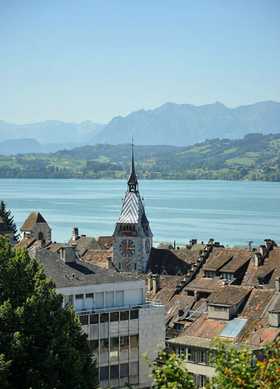
For one person, living costs in Zug are estimated at $4,859 a month, including rent and utilities – 38% above the national average. Rent and utilities take more than half of the total.
Real prices from locals and on-the-ground checks – rent, groceries, transit and the daily extras. Here's what a month in Zug actually costs, broken down by who's living it.
A single person spends around $4,859 per month with rent, or $1,960 for everyday expenses alone.
$4,859 /mo
A couple spends around $7,610 per month with rent, or $3,506 for everyday expenses alone.
$7,610 /mo
A family of three spends around $10.4K per month with rent, or $5,052 without housing.
$10.4K /mo
📊
Overall, Zug is 260–267% above the global median across household types. Within Europe, costs are 177% above average – among the most expensive in the region.
Midsize Hatchback 1.4l(Volkswagen Golf, Toyota Prius, Honda Civic, etc)
$42.7KCHF 35.2K
$35.0KCHF 28.8K
$43.0KCHF 35.4K
Compact Sedan 1.6l(Toyota Corolla, Mazda3, Kia K4, Hyundai Elantra, etc)
$39.2KCHF 32.3K
$39.2KCHF 32.3K
$39.2KCHF 32.3K
🧾 Monthly Utilities & Internet
Cost
Range
Utilities for 2 People in 2-bedroom Apartment(Heating, Electricity, Gas, Water, Garbage)(85m2)
$282CHF 232
$146CHF 121
$549CHF 452
SIM Card Monthly Plan(Calls and 10GB+ Data)
$38.06CHF 31.35
$24.34CHF 20.05
$60.9CHF 50.1
Internet(50+ Mbps, Unlimited Data)
$61.1CHF 50.3
$47.29CHF 38.95
$76.8CHF 63.3
🎉 Sport & Entertainment
Cost
Range
Gym Membership(Monthly)
$120CHF 98.5
$60.1CHF 49.48
$144CHF 119
Tennis Court(1 Hour on Weekend)
$32.37CHF 26.66
-
Cinema Ticket
$23.77CHF 19.58
$21.94CHF 18.07
$35.36CHF 29.12
🧸 Childcare & Education
Cost
Range
Preschool or Kindergarten, Full Day, Private, 1 Child(Monthly)
$4,114CHF 3,388
$3,526CHF 2,904
$4,702CHF 3,872
International Primary School, 1 Child(Yearly)
$35.2KCHF 29.0K
$31.9KCHF 26.3K
$45.6KCHF 37.5K
👕👟 Clothing & Footwear
Cost
Range
Jeans(Levis 501 Or Similar)
$165CHF 136
$121CHF 99.9
$194CHF 160
Summer Dress(H&M, Zara, etc)
$67.4CHF 55.5
$53.8CHF 44.31
$83.7CHF 68.9
Sport Shoes(Adidas, Nike)
$147CHF 121
$118CHF 97.1
$295CHF 243
Men's Leather Business Shoes
$270CHF 223
$241CHF 198
$300CHF 247
🏠 Accommodation & Living
Cost
Range
1-bedroom Apartment, City Center(Monthly)
$3,793CHF 3,124
$2,505CHF 2,063
$5,963CHF 4,912
1-bedroom Apartment, Outside City Center(Monthly)
$2,617CHF 2,156
$2,509CHF 2,066
$4,824CHF 3,973
3-bedroom Apartment, City Center(Monthly)
$6,963CHF 5,735
$6,057CHF 4,989
$12.1KCHF 9,977
3-bedroom Apartment, Outside City Center(Monthly)
$5,026CHF 4,139
$3,857CHF 3,176
$6,026CHF 4,963
Buy Apartment in City Center(m2)
$30.2KCHF 24.9K
$25.4KCHF 20.9K
$31.9KCHF 26.2K
Buy Apartment Outside City Center(m2)
$21.2KCHF 17.5K
$20.3KCHF 16.7K
$24.1KCHF 19.9K
💵 Salaries & Financials
Cost
Range
Average Monthly Net Salary(After Tax)
$7,148CHF 5,887
-
20-Year Fixed Mortgage Interest Rate(Annual %)
1.9
1.8
3
CityCost data is based on AI and user input – minor inaccuracies may occur.
Last update: October 10, 2026
Monthly budget structure
Share of the monthly basket for one person, rent included.
Share of the monthly basket for a family of three, rent included.
Zug$4,859
Zug$10.4K
🏠Accommodation & Living
$2.6K 53.9%
🛒Groceries & Markets
$631 13%
🍽Eating Out
$555 11.4%
🧾Monthly Utilities & Internet
$381 7.8%
👕👟Clothing & Footwear
$293 6%
🚌Getting Around
$215 4.4%
🎉Sport & Entertainment
$167 3.4%
🏠Accommodation & Living
$5K 48.5%
🛒Groceries & Markets
$1.5K 14.4%
🍽Eating Out
$2K 19%
🧾Monthly Utilities & Internet
$419 4.1%
👕👟Clothing & Footwear
$650 6.3%
🚌Getting Around
$439 4.2%
🎉Sport & Entertainment
$367 3.5%
Cost Breakdown
🏠A one-bedroom apartment in the city center costs around $3,793, dropping to $2,617 outside central areas. Housing accounts for roughly 53% of the average salary ($7,148) – well above the 30% international benchmark.
💰The average net salary is $7,148. With monthly costs around $4,859, saving is possible but often limited. A more comfortable lifestyle typically starts at $7,289.
🛒Groceries cost around $631 per month for one person. A mid-range dinner for two is priced at $171 – above the European average of $73.0.
🚌A monthly public transport pass costs about $157 – above the European average of $49.00.
Cost Highlights
⭐Zug has the 5th most expensive preschool or kindergarten, full day, private, 1 child worldwide
⭐Zug has the 7th most expensive chicken fillets worldwide
⭐Zug has the 8th most expensive family monthly cost (excluding rent) worldwide
Low risk of other local infectious diseases such as Lyme disease, Rocky Mountain spotted fever, Tick-borne encephalitis, Leishmaniasis, Chagas disease, and Sleeping sickness
Popular online taxi apps offering convenient, cashless rides in many countries, including Uber, Bolt, Grab, inDrive, DiDi, Careem, Gojek, Maxim, and Yango
Cost of Living in Zug - Frequently Asked Questions
How does Zug stack up for affordability for travelers, expats, and digital nomads?
Zug offers a high quality of life with consistently strong services, but costs sit on the higher end compared to many destinations. Cost of Living in Zug reflects its stable economy, educated workforce, and lakefront setting. You'll find well-maintained housing options, reliable public transit, and robust dining and leisure scenes, with premium price tags near the Old Town and lakeside. To keep value, consider smaller apartments, shared housing, or neighborhoods outside the core waterfront belt, and use coworking spaces that suit short- or long-term plans. Seasonal events can shift price ranges for activities, but everyday essentials stay predictable. Tip: set a housing and transit budget first, then explore neighborhoods by commute time rather than distance.
What would a typical day look like for a remote worker or student in Zug, including housing search, food options, transport, and errands?
A typical day blends lake views with efficient logistics. Start with a coffee near your coworking hub or a quiet corner of a train-friendly café, then handle errands at a well-stocked supermarket or around the weekly market. For housing, target neighborhoods near the station, the lake, or Baar to balance commute and space; use local portals and consider short-term leases to test options. Food options range from bakeries to casual eateries, plus seasonal markets for produce. Transport is punctual and reliable; a monthly pass or bike can trim costs. Understanding the Zug living cost helps you tailor your base. Tip: choose a base with easy transit connections to your daily destinations.
How can you maximize quality of life in Zug on a budget, and what neighborhood fit aligns with your lifestyle and seasonality?
To balance budget and lifestyle, group spending into housing, food, transport, and leisure. Compare neighborhoods by proximity to water, green spaces, and transit hubs; Altstadt and the lakefront offer walkability but higher rents, while newer districts may provide better value and larger spaces. Build a budgeting framework: set a monthly cap for rent, groceries, and activities, then track your spend loosely. Take advantage of markets, seasonal produce, and library or museum deals; in winter, indoor activities and cozy cafés become focal points. Tip: test a neighborhood in different seasons and choose based on how you feel during typical weekends.
What is the average cost of living in Zug in 2026?
For 2026, a single person in Zug should plan on about $4,859 per month with rent, or $1,960 without housing. That covers a moderate lifestyle – food, utilities, transport, and some leisure – at current local prices.
Why is Zug so expensive to live in?
Zug is expensive by global standards – monthly costs hit about $4,859. Housing is the main driver: central rents are steep, and even outer neighborhoods cost more than the global average. Strong demand, high local incomes, and limited supply all push prices up.
How much do you need to earn to live comfortably in Zug?
You'll want at least $7,289 per month after taxes to live comfortably in Zug. That covers a decent apartment, groceries, utilities, transport, and enough left over for dining out occasionally. Families or people wanting a central location should budget higher.
How much is rent in Zug?
A central one-bedroom apartment in Zug runs about $3,793 per month. Move further out and that drops to around $2,617. Location makes a big difference here – and furnished places or short-term rentals will cost more on top of these figures.
Is food expensive in Zug?
Groceries in Zug aren't cheap – expect to spend around $631 per month. Even basic staples are priced above global averages, and organic or imported products push the bill higher. Cooking at home still saves money versus eating out, but food is a noticeable expense here.
How much is public transport in Zug?
Getting around Zug by public transport costs about $157 per month. A monthly pass generally covers buses, trams, and metro – much cheaper than owning a car for the daily commute.
Is $3,000 enough to live comfortably in Zug?
$3,000 in Zug is a stretch – monthly costs with rent hit $4,859, and housing alone takes a big chunk. Even with a shared flat and minimal going out, there's very little buffer for surprises or savings.
Is Zug a good place to live?
Quality of life in Zug is genuinely good – highlights include fast internet, low crime rates, clean air, and monthly costs hover around $4,859. Day-to-day life is well-rounded: decent infrastructure, varied dining and entertainment, and a generally positive atmosphere.